Astrecovo MTF
The History of the Astretsovo Metal Toy Factory
In the small village of Astretsovo in the Dmitrovsky District of Moscow Oblast once stood one of the first and the largest metal toy factories in Russia. Today almost nothing remains to remind us of it, yet for nearly a century and a half tin cars, toy soldiers, locomotives and many other toys that are still remembered by several generations travelled from here across the entire country.
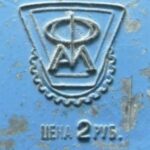
At first these were simple whistles, pipes and horns (“valtorny”). Later the workshop also started producing household items — tea caddies, sugar bowls and other utensils. The toys sold well, especially in Sergiyev Posad. Business went so well that within a few years the workshop had turned into a real factory. By the end of the 19th century it was already called “P. P. Talayev & Sons Metal and Mechanical Toy Factory”.
The Talayevs’ products received awards at exhibitions in Nizhny Novgorod, St Petersburg and even Paris. The firm’s 1912 letterhead was decorated with medals won between 1890 and 1905, including a gold one. By that time around seventy similar tin workshops had appeared around Dmitrov, but the Talayev factory remained the largest and best-known.
During the First World War the factory almost stopped making toys. Instead it produced hand grenades, buckets, kettles and “burzhuyka” stoves. After the Revolution the enterprise was nationalised and later closed completely. In 1923, however, it was restored — now as the Andreyevskaya artel. Toys were made again: Red Army soldiers, bathtubs, irons and other items.
During the Great Patriotic War the factory once more switched to military needs. It produced first-aid kits for tanks and ships, mugs, mess tins and spirit lamps. On 27 November 1941 German troops occupied the village. They damaged the finished products and some of the equipment. After Astretsovo was liberated, work resumed.
After the war the factory returned to making toys. The range became enormous: trucks, tractors, cars, locomotives, carriages, ships, trams, buckets, watering cans, irons… Almost every child in the USSR saw or held an Astretsovo toy at least once. Especially famous were the toy soldiers designed by the sculptor Boris Dmitrievich Savelyev (1928–2019). Among his most popular sets were “Warriors of the Middle Ages”, “The Red Cavalry” and “Horsemen of 1812”. The soldiers were made using a special technique: two halves were cut from a sheet of metal, the relief was stamped, the halves were soldered together, weapons were attached and the figures were painted.
Over time the technology changed. Soldering was replaced by riveting, then by electric welding. Hand painting gave way to mechanical painting. Lithographed tin appeared, which no longer needed to be painted. The toys became simpler and were produced in large quantities, yet they remained recognisable and well-loved.
The factory operated until 1990. Today its buildings are used for other purposes, while the toys themselves can be seen in the Dmitrov Local History Museum, in private collections and in old photographs. Several books have been written about this unique craft; one of the best-known is “Astretsovo Toys” by Yuri Vyacheslavovich Yemelyanov. I was fortunate enough to know the author of this interesting book personally.
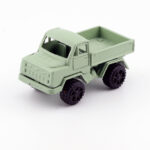
What interests us most in the whole history of the factory is the production of small-scale die-cast metal cars. In 1975 the factory produced a wonderful little truck in which one could recognise the GAZ-53. It was made in different colours. The fixed price in late 1970s was 85 kopeks. As a child I had a light-green one and a red one.
Thus a small village workshop founded by a simple peasant became an entire chapter in the history of Russian toys.
GAZ
GAZ-53