History of 1/64 scale diecast cars in the USSR
Collectors around the world very well know the USSR made die-cast metal cars of 1:43 scale. These high-quality models are sought for by many collectors. The legend goes that a director of …… on one of his international business trips saw a model of Soviet Moskvitch 412 car produced by Corgi, this inspired him to start production of similar toy cars in the USSR. He succeeded, and the business took off. Unfortunately, perestroika in the USSR ruined this great undertaking as well as many others.
The history of smaller scale die-cast cars looks quite different. Today we can say with certainty that only a very few models were ever made. In the late 1970s Minsk factory produced a model of Zhiguli 2101 — also known by its nickname “Kopeyka” (Penny) – as it was affectionately called by people. Zhiguli 2101 was the very first model of Volga Automobile Plant (VAZ) in Tolyatti. While it wasn’t exactly a high-quality replica, it was more of a toy, still it represented a true breakthrough. It was the first 3-inch scale die-cast metal car that appeared in the USSR. The scale of 1:60 was indicated on the bottom of the car as well as the price of 2 rubles and 50 kopeks. This was far from cheap: a loaf of high-quality bread would cost 18 kopeks and a full meal at a factory canteen was only 50 kopeks at a time.
For the 1980 Olympics a series of VAZ-2101s was released in plastic boxes featuring the Olympics-80 symbols. Today, these are valued more than any other series, even the earlier releases of the model. VAZ produced cars for the domestic market under the name of “Zhiguli,” while the same cars for export were named “LADA.” The original box of Minsk produced model indicated VAZ-2101, later it changed to LADA.
The cars were produced in several colors, the most common was light green with a red interior — I had one of those. Slightly rarer were the blue, gray-beige and burgundy ones. The base was metal, either painted silver or left unpainted. It was held in place by rivets. All the cars had plastic wheels on thin metal axles.
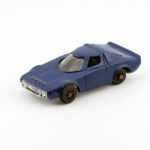
The Tula Cartridge Plant produced a series of military vehicles, including the GAZ-69, also known as the “Gazik” or “Kozel” (Goat). These were also in scale close to our 1:64.
…and this is it – the entire list. Now you understand why a Matchbox car meant so much more to a Soviet boy than to his British or American fellow of the same age. Many born in the 1960s and 70s will see their first 1:64 scale toy car only in the 1990s, when a flood of foreign toys hit the Russian market, but even then, these weren’t exactly the high-quality Matchbox or HotWheels models.
Needless to explain that an average boy in the USSR couldn’t just go to a toy store with his parents and buy a racing track. My first racing track I made together with my classmate was made with plastic handrails that we stripped from a staircase in a nearby building. My friend’s father played in the Bolshoi Theater orchestra. He often traveled on tours of this legendary theater abroad and used to bring his son various colorful Matchbox cars. These made a massive impression on us, his son’s friends. The cars raced down our handmade grey track. It was out of question to let such a precious toy car to hit anything, thus there was a soft pillow thoughtfully placed at the end of the track, so that the cars would land in it at the end of their run.
to be continued …